

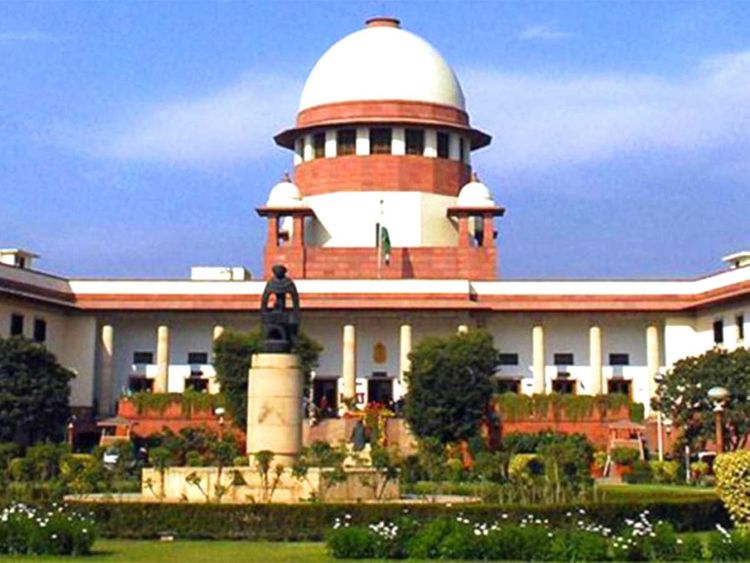
NEW DELHI MAY 01: The Supreme Court Monday held that it could grant divorce on the grounds of “irretrievable Breakdown” of marriage by invoking its Special Powers under Article 32 of the Constitution.
A Constitution Bench, comprising Justices S K Kaul, Sanjiv Khanna, A S Oka, Vikram Nath, and J K Maheshwari, said such an exercise of power “will not contravene the Principles of public policy”.
The Court also held that it could waive the six-month waiting period, which is Mandatory Before a couple can approach a Court seeking divorce by mutual consent, subject to conditions.
This comes only days after a two-judge bench of the court said that irretrievable breakdown of a marriage can be read as amounting to cruelty under the Hindu Marriage Act, 1955, and can be a ground for divorce.
The April 27 ruling came while deciding a case in which a couple lived together only for four years, had been living separately for 25 years and had multiple litigations between them. The court held that “a marriage, which has broken down irretrievably, in our opinion, spells cruelty to both the parties, as in such a relationship, each party is treating the other with cruelty. It is therefore a ground for dissolution of marriage under Section 13 (1) (ia) of the Act”.
It said that though “irretrievable breakdown of a marriage may not be a ground for dissolution of marriage, under the Hindu Marriage Act, but cruelty is”.
A marriage can be dissolved by a decree of divorce, inter alia, on the ground when the other party has, after the solemnisation of the marriage, treated the petitioner with cruelty. In our considered opinion, a marital relationship, which has only become more bitter and acrimonious over the years, does nothing but inflicts cruelty on both the sides. To keep the façade of this broken marriage alive would be doing injustice to both the parties,” said the bench in its April 27 ruling.

